Fed Has Never Hiked In October Ahead Of US Elections: UBS
The US-Iran conflict has pushed Brent crude toward $106 a barrel, while the 10-year Treasury yield has climbed to its highest level in nearly two decades. Traders are looking at whether elevated energy prices will make inflation sticky and prompt another Federal Reserve rate hike in late October.
This week's US economic releases could reinforce those new concerns. Stronger growth would give the Fed greater mobility to tighten policy, while inflation would strengthen the case for further rate hikes.
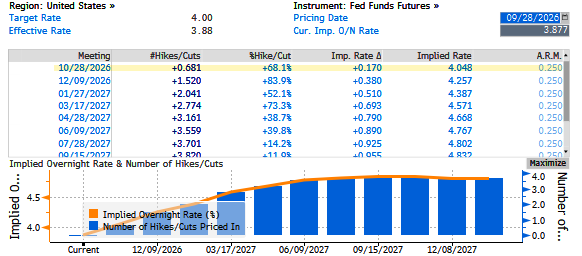
UBS' Simon Penn wrote in a note early Monday that traders were assigning a 68% probability to another hike next month. He said that markets are underestimating the potential for restraint ahead of the midterms.
Penn continued:
Fed Has Never Hiked In October Ahead Of A US Election
The market prices 17.4bp or a 69% chance the Fed will raise rates again at its Oct. 28 meeting. It is extremely unlikely the Fed will do so. Since 1990, the Fed has never raised rates when it's had a meeting in October, just ahead of an election in November. There are only three occasions (2004, 2018 and 2022) in the last 35 years when the Fed has hiked in September, when that was the meeting immediately preceding an election.
Central banks all like to say decision making is entirely independent of political activities. But it is also common that central banks refrain from policy actions in the final run-up to major political events.
Taking out the pricing for October doesn't mean December should reprice as a possible 50bp hike (market has an aggregate 38bp for December). Rather, it should just push out through the strip. December pricing should be closer to the full 25bp. From a trading perspective, the balance is likely to be shared out in the January and March meetings (12bp and 18bp vs prior meeting respectively), but looking at the market all told and the longer term trade should be to fade the back end and bring cumulative pricing back to 75bp over the next year from the current 91bp.
In detail:
- The 2022 hike was the most aggressive, a 75bp move during the rapid tightening cycle to combat post-pandemic inflation - the largest pre-election hike in the modern era.
- The 2004 hike was part of a steady, gradual tightening cycle that began in June 2004 and continued uninterrupted through the election.
- The 2018 hike came despite public pressure from the Trump administration to hold rates steady ahead of the midterms.
- In all other election years since 1990 - including 1992, 1994, 1996, 2000, 2002, 2006, 2008, 2010, 2012, 2014, 2016, 2020, and 2024 - the Fed did not hike in September or October.
To start the week, yields on US 10- and 30-year Treasuries jumped to their highest levels since 2007 and 2004, respectively.
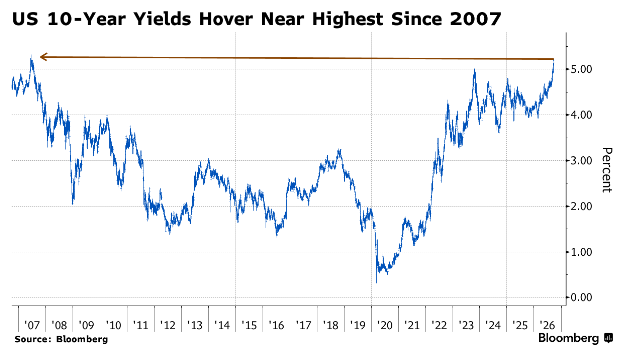
UBS markets analyst Nana Antiedu cited US equity strategist Keith Parker in a note earlier today, saying that higher yields have already squeezed stock valuations substantially, creating the potential for a larger rebound if yields fall.
Antiedu continued:
US Equities: Position For Period Of Elevated Rates, Asymmetry To Lower Rates
Parker finds that the sharp rise in US Treasury yields has triggered a significant equity valuation reset, with the S&P 500's next-twelve-months P/E down 17% since November as the 10-year yield has climbed around 100bp year-to-date. Keith notes the derating is approaching recession-style levels and comparable to the 1994 hiking cycle.
History suggests equity performance from here will largely depend on the Fed. When rates stabilised without aggressive tightening (less than 100bp+ a year), the S&P 500 typically delivered double-digit returns over the following year. However, full hiking cycles (hiking by over 100bp within a year) have historically led to flat or negative returns. Keith finds that equities have greater asymmetry to a fall in yields than the downside from higher rates. Keith suggests positioning for a period of elevated rates, and asymmetry to lower rates. Comparing his Composite REVS scores to rates betas, top ranking subindustries Semis, Pharma, Refining and Div Banks remain attractive and appear less exposed to rates.
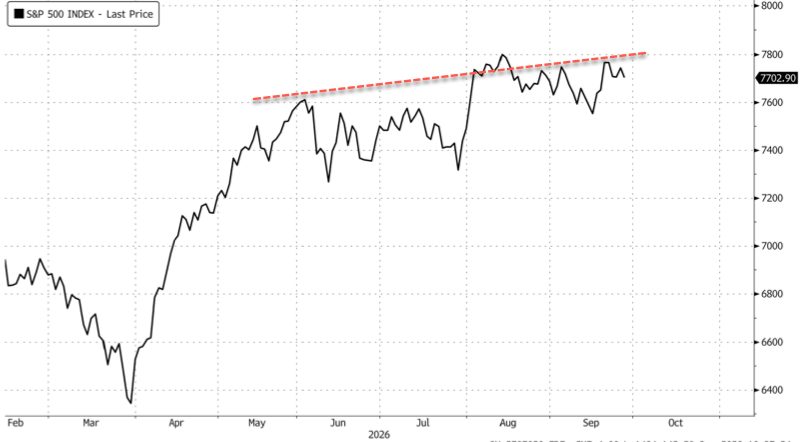
Goldman notes speratly that stocks tend to hit resistance once the 10-year Treasury moves by about 30 basis points in two weeks or 50 basis points in a month. It's up 28 since September 9 and 37 since August 21.
Read: 3 Bond Volatility Charts We are Watching
What's clear is that traders are caught between an energy shock and inflation woes that put the Fed on a longer runway for rate hikes. Bulls are betting that yields stabilize before borrowing costs undermine stocks, opening the door to a powerful relief rally if energy prices peak and resolutions to the conflicts in the Gulf and Ukraine come into focus. But if energy prices stay high and economic data keep the Fed tightening, more market trouble could be just ahead.