Boats And RVs Still Break The Bank. Citi Reveals Which Leisure Vehicles Are Becoming More Affordable
Citi analysts examined recreational vehicles and boats and found that high prices and elevated financing costs are keeping much of the market under pressure. There's some good news: motorcycles, off-road vehicles, and motorized RVs have become more affordable relative to incomes.
Citi leisure analyst James Hardiman wrote in a note on Monday that investors typically group RVs, boats, motorcycles, and off-road vehicles together in terms of macro factors. But he noted that "these categories face very different affordability backdrops," contrary to investor beliefs.
"Towable RV and boat payments remain well above their historical share of buyer income, and while motorcycle/ORV payments are up meaningfully, this has been outpaced by income growth," Hardiman said, adding, "The relative retail performance of these categories supports the conclusion that affordability, rather than a uniform pullback in discretionary spending, is the biggest factor separating the winners from the losers."
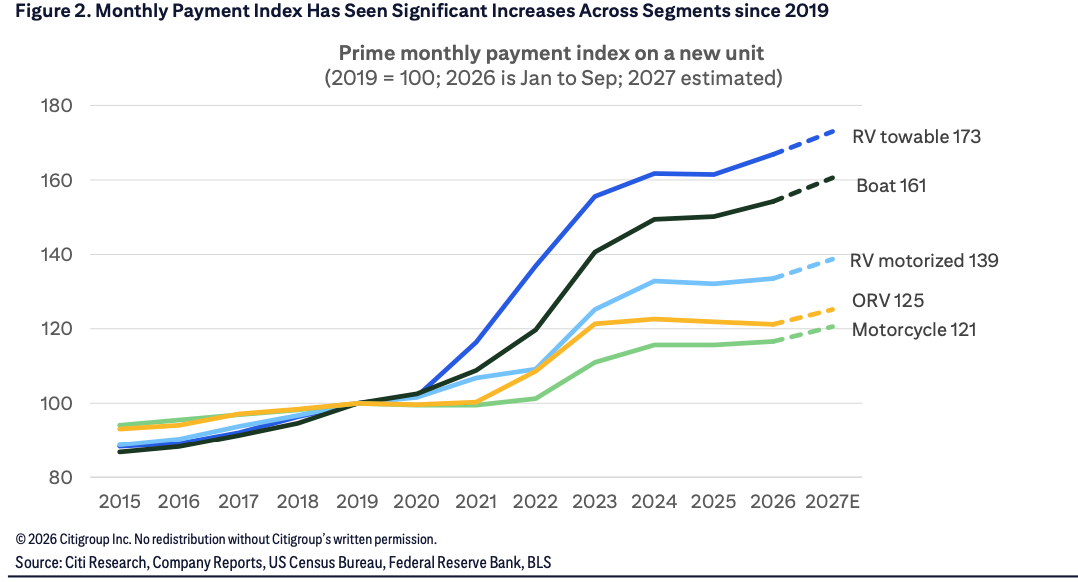
Hardiman estimates that monthly payments on a comparable new towable RV are 67% above 2019 levels, while boat payments have risen 54%.
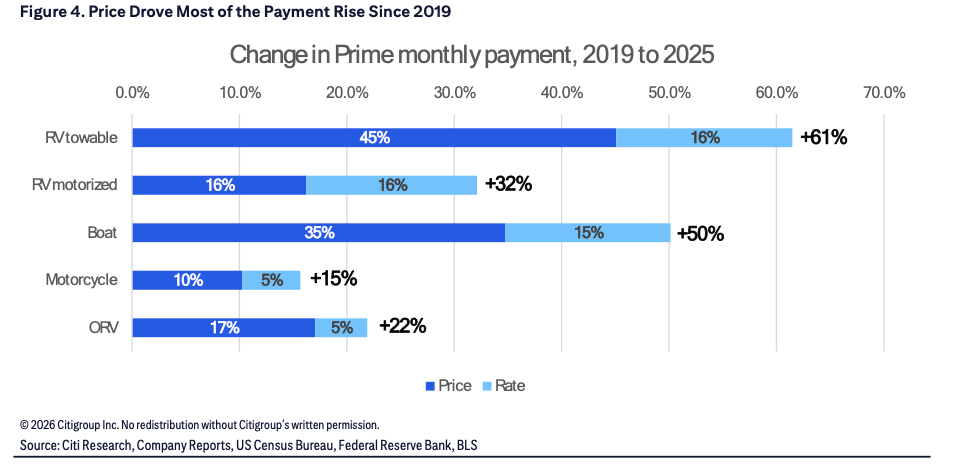
He said unaffordable towable RVs and high financing costs have forced buyers to trade down. "Buyers have responded by trading down to smaller, less expensive, and lower-content units, but that mix shift has not solved the underlying affordability problem," he wrote.
There is some good news: motorcycles and off-road vehicles like Polaris RZRs tell a much different story and have become more affordable relative to incomes. He said that although monthly payments have increased 17% and 21% since 2019, respectively, buyer income growth has more than offset those increases. Motorized RV affordability is roughly unchanged from 2019.
Here are the highlights from the note:
Towable RVs remain at the center of the affordability crisis. The monthly payment on the same new towable is 67% higher than in 2019 and now consumes 4.4% of a typical buyer household's income, up from ~3.5% in 2019. More importantly, the payment consumes 26% more of the buyer's discretionary income than it did in 2019, even after improving from 38% above 2019 at the 2024 peak. Buyers have responded by trading down to smaller, less expensive, and lower-content units, but that mix shift has not solved the underlying affordability problem.
Boats face a similar but somewhat less severe problem. Boat payments stand 54% above 2019, consuming 5.7% of buyer income vs. 4.9% in 2019. Measured against discretionary income, the payment burden stands 16% above 2019, after peaking at ~25% above in 2024.
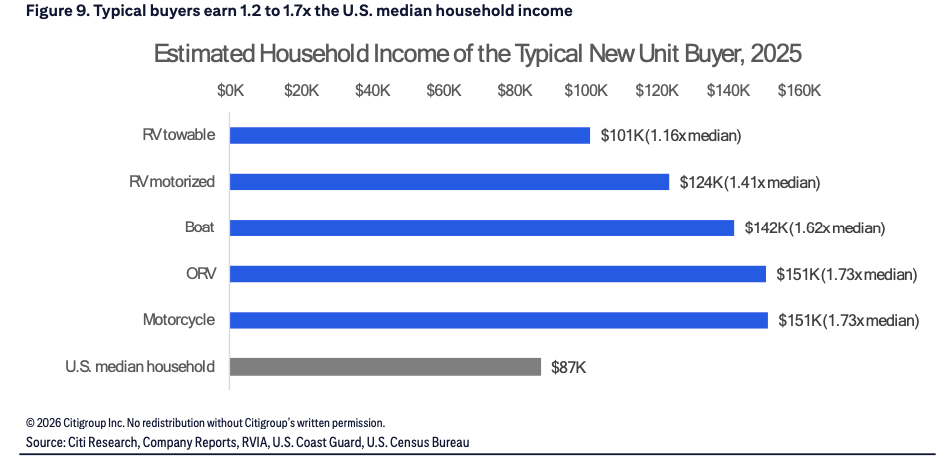
Contrary to popular belief, neither motorcycles nor ORVs face an affordability crisis; quite the contrary. Motorcycle payments consume 4.0% of typical buyer income vs. 4.6% in 2019, while ORV payments consume 3.4% vs. 3.7% in 2019. Measured against discretionary income, motorcycles are 13% more affordable than in 2019 and ORVs are ~10% more affordable, as discretionary income growth has more than offset payment increases of 17% and 21%, respectively, helping explain both categories' relative retail outperformance.
Hardiman's 2027 outlook on financing rates for outdoor leisure items is unlikely to bring relief anytime soon:
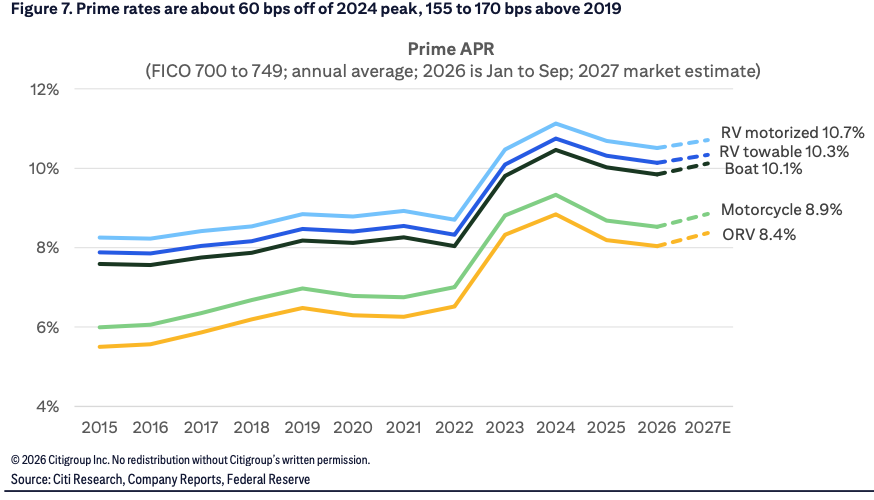
2027 is unlikely to bring meaningful affordability relief: Based on forward market expectations, prime borrowing rates could rise another 44 to 51 bps by late 2027, while we assume prices increase 2.5% across categories.
Together, these factors would drive monthly payments 3% to 4% higher, including 2.5% to 3.0% from rates for RVs and boats versus roughly 1% for powersports given their shorter loan terms. Assuming buyer income grows 3.75% and the share available for discretionary spending remains near current levels, affordability should remain roughly flat overall, preserving rather than closing the current gap. Towable RVs and boats would remain stretched, while motorcycles and ORVs should retain their relative affordability advantage.
The affordability squeeze is set to follow towable RVs and boats into next year, keeping demand well under pressure and potentially weighing on manufacturers' shares.
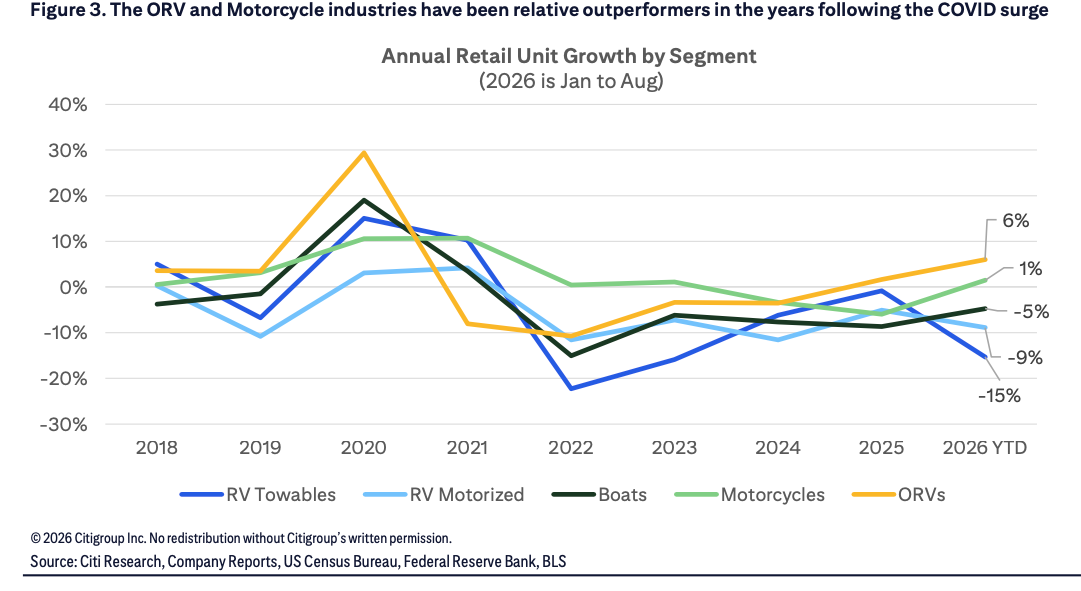
Motorcycles and off-road vehicles look brighter, with payment burdens relative to income below 2019 levels, while motorized RVs are roughly back to pre-pandemic levels.