Oh, By The Way, Private Credit Defaults Just Hit A Record...
Submitted by QTR's Fringe Finance
While Wall Street remains preoccupied with unfolding shitshow in tech and AI right now, there’s another little problem quietly developing beneath the surface from a sector I’ve been warning about nonstop for 2 years: private credit defaults just hit a record high.
According to Forbes, citing Fitch Ratings’ latest third-quarter private credit report, the U.S. private credit default rate climbed to 6.3% over the trailing 12 months, up from 6.0% in the previous quarter. It’s the highest reading in Fitch’s series, which has now deteriorated for five consecutive quarters.
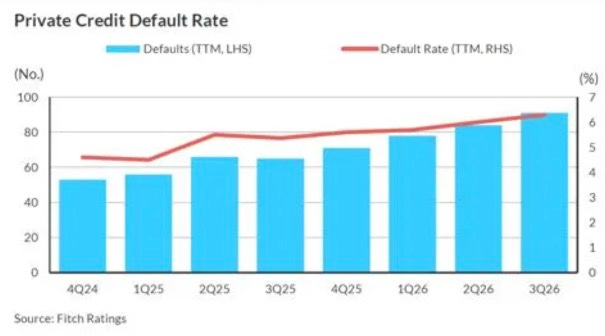
Fitch recorded 27 default events in the third quarter alone, compared with 20 in the second quarter, bringing the trailing annual total to 91 unique borrowers.
But check this out…roughly 88% of those defaults involved some form of restructuring rather than an outright bankruptcy. Lenders are allowing struggling borrowers to defer interest, capitalize unpaid interest into additional debt, or extend loan maturities rather than force an immediate reckoning.
In other words, the financial industry’s favorite pastime of extend and pretend is alive and well. About half of the defaults involved interest deferrals or payment-in-kind arrangements, while another 38% involved distressed maturity extensions. These arrangements can keep companies technically operating while doing very little to fix the underlying problem: too much debt and not enough cash flow.
And the trouble isn’t evenly distributed. Fitch found default rates of 9.7% in both industrial and manufacturing businesses and consumer products and services. Healthcare providers accounted for 16 individual defaults over the past year.
Moody’s has identified similar problems. Its analysis of middle-market borrowers found that a reported 4% default rate increased to 5.8% when distressed debt exchanges were included.

The bigger concern is what happens next. A substantial wave of private loans originated during the cheap-money years of 2020 through 2022 will need refinancing in 2027 and 2028. Many of these companies borrowed under financial conditions that no longer exist, and some have already exhausted their easiest options for postponing repayment.
Moody’s found that borrowers with deeply speculative credit profiles account for more than half of the debt coming due in those two years within its middle-market CLO sample. That means the next couple of years could force lenders to confront losses they’ve spent years trying to postpone.
To be clear, this doesn’t mean the entire private credit market is about to implode. Senior creditors have structural protections, and some borrowers will undoubtedly refinance or recover. But it does suggest that the industry’s apparent stability deserves considerably more skepticism than it’s been receiving.
I’ve been arguing that the financial system is increasingly dependent on perpetual refinancing, accommodating creditors, and the assumption that somebody will always be willing to provide another round of capital.
Private credit is now offering a particularly revealing test of that assumption.
The defaults are already at records, the maturity wall is approaching, and much of the distress is being managed by pushing obligations further into the future. This cannot last forever…Extend And Pretend Eventually Comes To An End
It’s worth remembering that financial crises don’t usually begin when everyone suddenly realizes there’s a problem. They begin when the mechanisms used to conceal or postpone the problem stop working.
85% OFF FOREVER IF YOU SUBSCRIBE TODAY: I am again offering an 85% discount to anyone that wants to become a Fringe Finance annual subscriber today. It’s a discount you can keep and stays applied for as long as you wish to remain a subscriber: Get 85% off forever
And right now, private credit looks like an industry that’s doing an awful lot of postponing while the broader market burns in the background. Lenders are restructuring loans, extending maturities, and finding increasingly creative ways to avoid recognizing losses. But none of that changes the underlying economics. It merely buys time, and time becomes a very expensive commodity when liquidity is disappearing, credit conditions are tightening, and investors are becoming increasingly unwilling to take risks.
My concern is that the panic, restrictiveness, and desperate scramble for liquidity we’re beginning to see elsewhere in the financial system will eventually spread to every corner of the credit markets.
When that happens, the luxury of kicking the can down the road disappears. Lenders will want their money back, borrowers will find refinancing increasingly difficult, and the entire industry’s favorite strategy of “extend and pretend” could very quickly become “pay us right fucking now.”
And that, dear reader, is when we find out just how much trouble has been hiding beneath the surface.

QTR’s Disclaimer: Please read my full legal disclaimer on my About page here.